


Reviewed by: Mansoor Ali, Technical Editor, PenPonder | Last Updated: July 2026
Quick verdict: Perplexity is the best AI research tool available at $20/month. It is not a Google replacement. It is a research accelerator. Those are different jobs.
What Is Perplexity AI?
Perplexity launched in 2022 as an answer engine — a search tool that reads the web and gives you a direct, cited answer instead of ten blue links. By July 2026 it has over 45 million active users and processes roughly 1 billion queries per month.
The core idea is simple. You ask a question in plain English. Perplexity searches multiple sources simultaneously, synthesises the results, and gives you an answer with numbered citations you can click to verify. No ads. No SEO-stuffed filler. Just the answer.
In February 2026 Perplexity formally abandoned advertising entirely. As one executive told the Financial Times: a user needs to believe this is the best possible answer — and ads erode that. The company now runs on subscriptions only.
That decision matters. Google’s search results in 2026 have 4-6 ad positions before organic results. Perplexity has none.
Perplexity AI Pricing 2026
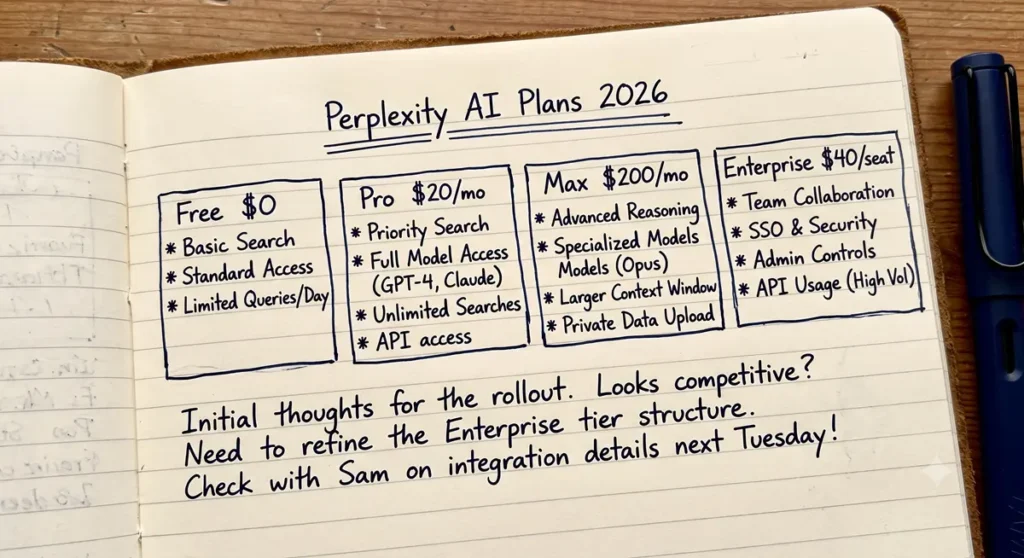
Complete pricing breakdown — all plans
| Plan | Price | What You Get | Best For |
|---|---|---|---|
| Free | $0 | Unlimited standard searches, ~5 Pro searches/day, all 6 Focus modes | Casual research, fact-checking |
| Pro | $20/mo ($200/yr) | Unlimited Pro Search, ~20 Deep Research/day, GPT-5 + Claude + Gemini access, file uploads, Comet browser | Researchers, writers, analysts |
| Education Pro | $10/mo | Everything in Pro at half price — verified students only via SheerID | University students |
| Max | $200/mo ($2,000/yr) | No limits, Model Council (runs query across 3 AI models simultaneously), Perplexity Computer, unlimited Labs | Power users, professional researchers |
| Enterprise Pro | $40/seat/mo | Pro features plus SSO, admin controls, shared spaces, no training on data | Teams, organisations |
| Enterprise Max | $325/seat/mo | 4,000 Pro searches/week, 500 Deep Research/month, dedicated account manager | Research-heavy organisations |
Important note on annual billing: Pro at $200/year saves roughly $40 versus monthly. Only commit annually after one paid month confirms it fits your workflow.
Free paths to Pro: Download the Comet browser and run one search for one free Pro month. Airtel India subscribers get 12 months free via the Airtel Thanks app. Xfinity US subscribers get 12 months free at xfinityrewards.com. Samsung Galaxy device owners in the US get 12 months free via the Galaxy Store.
Key Features — What Perplexity Actually Does
Pro Search and Deep Research
Standard search gives you a quick cited answer. Pro Search goes deeper — it spends more time on the query and produces a more detailed, sourced response. Deep Research goes further still: it can generate full multi-page reports from a single prompt, spending several minutes pulling and synthesising dozens of sources.
This is the feature that makes Perplexity Pro worth $20/month for anyone who does regular research. What used to take 30 minutes of tab-hopping gets done in two.
Focus Modes
All six Focus modes are available on the free tier. This is more useful than it sounds:
- Web — standard multi-source search
- Academic — pulls from peer-reviewed papers and journals
- Reddit — surfaces community discussions and real user experiences
- YouTube — searches video transcripts
- News — recent news sources only
- Wolfram Alpha — for maths, science, and quantitative queries
The Academic mode alone makes Perplexity worth trying for students and researchers. Getting cited, peer-reviewed sources on any topic in seconds is genuinely useful.
Model Selection (Pro and Max)
Pro subscribers can choose which underlying model handles their query — GPT-5, Claude Opus 4.6, Gemini 3 Pro, or Perplexity’s own Sonar model. For $20/month, this gives you access to multiple frontier models in a single interface. Subscribing to each separately would cost $20-$60 per service.
Max adds Model Council: it runs your query simultaneously across three frontier models and synthesises the results, showing you where they agree and where they diverge. Useful for high-stakes research where you want multiple perspectives stress-tested against each other.
Spaces
Spaces let you create persistent research environments with pre-set instructions, uploaded files, and custom AI behaviour. Think of it as a project folder for ongoing research — you define the context once and every search in that Space uses it. Available on all plans.
Perplexity Computer (Max only)
Launched February 2026, Computer orchestrates 19 different AI models as sub-agents on complex tasks. You assign a goal — analyse this market, research these competitors, produce this report — and Computer breaks it into subtasks, routes each to the best-fit model, and delivers a synthesised result. At $200/month it targets professionals who use Perplexity as core work infrastructure, not occasional users.
Comet Browser (Free)
Perplexity dropped the paywall on Comet in March 2026. It is now free on iOS, Android, Windows, and Mac. Comet is a Chromium-based browser with Perplexity’s AI search built in — agentic search, page summarisation, voice mode, and Deep Research from inside the browser without switching tabs. Worth downloading even if you stay on the free plan.
The Honest Accuracy Problem
This is the part most Perplexity reviews skip. It is the most important thing to understand before you rely on this tool for anything serious.
Perplexity claims 94% citation accuracy. That metric measures whether a cited source exists — not whether it actually supports the claim made. The Columbia Journalism Review ran an independent audit and found a 37% error rate in standard Perplexity responses. Failures split into two categories: misattribution (correct fact, wrong source attached) and fabrication (incorrect fact with an irrelevant citation). The Pro tier was sometimes more confidently wrong than Free on certain query types.
Deep Research mode improves this significantly. A 2026 Towards AI evaluation found Perplexity Deep Research scores 92.3% citation accuracy. That is directionally better — but still means roughly 1 in 12 claims needs verification.
What this means in practice: Use Perplexity to find sources and get a first-pass synthesis. Then click through and verify the claims that matter before you cite or publish them. Treat the citations as a starting point, not a finished fact-check.
Perplexity vs Google: When Each One Wins
This is not really a competition. They solve different problems. The clearest framework:
| Query Type | Use Perplexity | Use Google |
|---|---|---|
| Multi-source research | ✅ Synthesises and cites | ❌ Returns links to dig through |
| Local search (restaurants, directions) | ❌ No local data layer | ✅ Google Maps integration |
| Fact-checking a claim | ✅ Cites sources directly | ⚠️ AI Overviews sometimes unreliable |
| Shopping and product research | ⚠️ Text-based only | ✅ Price comparison, merchant reviews |
| Academic research | ✅ Academic Focus mode | ⚠️ Need Google Scholar separately |
| Deep research reports | ✅ Deep Research mode | ❌ Not available |
| Quick factual lookups | ⚠️ Works but slower | ✅ Faster for simple queries |
| Current news and events | ✅ News Focus mode | ✅ Both work well |
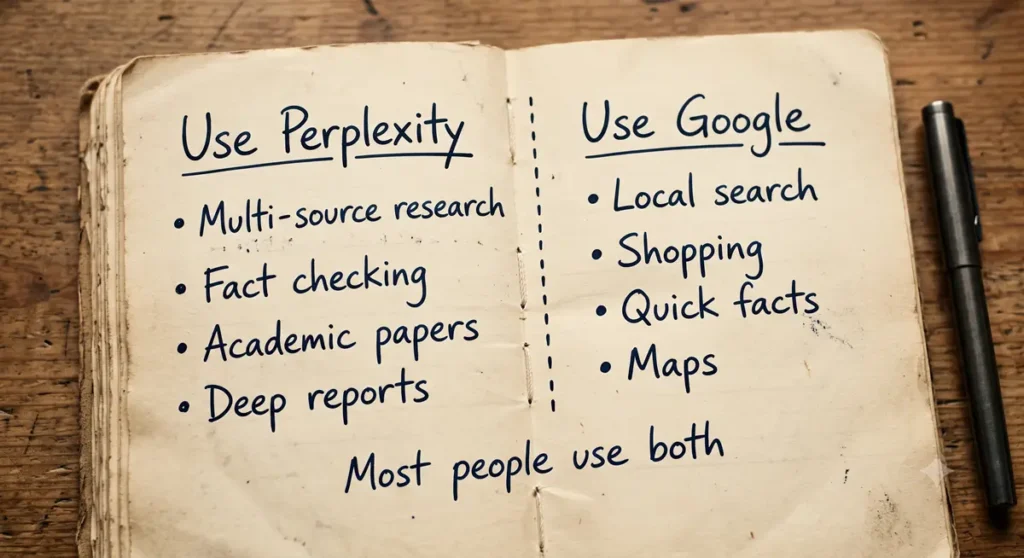
The most effective workflow in 2026 — used by most serious researchers — is not replacing Google with Perplexity. It is knowing which one fits the query. Google for local, quick, and transactional. Perplexity for research, synthesis, and verification.
Perplexity vs ChatGPT: The Key Difference
Both are AI tools. The difference is purpose.
Perplexity is built around search — it always grounds its answers in live web sources with citations. It is designed for research where you need to verify where information comes from.
ChatGPT is built around conversation — it can write, code, analyse, roleplay, and reason through problems without necessarily citing sources. It has web search capability but it is not the core function.
The highest-performing research workflow many professionals use in 2026: Perplexity for sourced research → Claude or ChatGPT for drafting and analysis from that research. Each tool does one thing well. For the full head-to-head breakdown between these two specifically, see our Perplexity vs ChatGPT comparison.
For a full comparison of AI assistants including ChatGPT and Claude, see our Best AI Writing Tools 2026 guide.
What Perplexity Does NOT Do Well
Every review that only lists features is hiding something. Here is what Perplexity genuinely struggles with:
Creative writing and long-form content. It is a research and answer tool. If you want help writing an article, a report, or a pitch, use Claude or ChatGPT. Perplexity was not built for this.
Complex reasoning and analysis. It synthesises what the web says. It does not reason through novel problems the way Claude or GPT-5 can. For judgment calls — which tool should I pick, what strategy should I follow — Perplexity gives you a synthesis of existing opinions, not an original analysis.
Citation reliability on standard searches. The 37% error rate from the Columbia Journalism Review audit means you cannot trust individual citations without clicking through. Deep Research is significantly more accurate. Standard search is not.
Customer support. Pro users have reported usage quotas reduced without notification, annual subscriptions downgraded unexpectedly, and refund requests rejected despite being within stated policies. Support is largely automated with long resolution times. Use monthly billing until you have tested the tool for your specific workflow.
Image and video generation. Pro users get limited video generation (around 3 videos per month). It is experimental. Do not choose Perplexity for visual content generation — Midjourney, Sora, and Runway are better options for that.
Who Should Use Perplexity AI
Researchers and analysts. This is the primary audience and where Perplexity earns its price. Multi-source synthesis, Academic Focus mode, Deep Research reports — if your work starts with finding and verifying information, Pro at $20/month is one of the best value subscriptions in AI.
Journalists and fact-checkers. The citation discipline changes how you research. Every claim comes with a source you can click and verify. It does not eliminate hallucinations — but it makes them visible in a way most AI tools do not.
Students. Education Pro at $10/month with Academic Focus mode is one of the most practical AI tools available for academic research. Verify the citations before using them in assessed work.
Compliance and legal professionals. For research into regulations, case law, and policy documents, Perplexity’s Academic and Web modes surface authoritative sources faster than manual research. For how AI compliance specifically intersects with tools like Perplexity, see our 2026 AI Compliance Guide and the EU AI Act enforcement requirements.
Skip it if: You primarily need creative writing assistance, coding help, long-form content drafting, or local search. ChatGPT and Claude handle writing and reasoning better. Google handles local and transactional queries better.
Final Verdict
Perplexity Pro at $20/month is the best AI research tool available at that price point. Nothing else gives you live web search, cited answers, multiple frontier AI models, Academic Focus mode, and Deep Research in one interface for $20.
It is not a Google replacement. It is not a ChatGPT replacement. It is a research accelerator — and it is very good at that specific job.
The citation accuracy problem is real. Treat every standard search answer as a starting point, not a finished fact. Click the citations. Verify what matters.
Start with the free tier. Five Pro searches per day is enough to decide whether it fits your workflow. If you regularly hit that limit within the first week — upgrade to Pro. If you don’t, the free tier is enough. For the complete AI tools landscape beyond just Perplexity, see our Best AI Tools 2026 roundup.
Frequently Asked Questions
Is Perplexity AI free?
Yes. The free tier includes unlimited standard searches with citations, five Pro searches per day, all six Focus modes, and the Comet browser. It is genuinely useful for casual research — not a crippled demo.
Is Perplexity AI better than Google?
For research synthesis and multi-source fact-checking, yes. For local search, shopping, and quick practical lookups, no. They solve different problems. Most effective users run both.
How much does Perplexity Pro cost?
$20 per month or $200 per year. Students with a verified university email pay $10 per month through the Education Pro plan. Several carrier partnerships offer 12 months of Pro free — Airtel India, Xfinity US, and Samsung Galaxy devices in the US.
Is Perplexity AI accurate?
Standard searches have a documented 37% error rate according to a Columbia Journalism Review audit. Deep Research mode scores 92.3% citation accuracy in independent testing. Always verify citations that matter before publishing or sharing them.
What is Perplexity Max?
The $200/month premium tier launched in mid-2025. It adds Model Council (simultaneous queries across three frontier AI models), Perplexity Computer (multi-agent task orchestration), and removes all limits on Pro Search and Deep Research. Worth it for professionals running Perplexity as core research infrastructure — not for occasional users.
What is Perplexity used for?
Research synthesis, fact-checking, literature reviews, competitive analysis, current events research, and academic paper discovery. It is specifically strong for queries that require pulling from multiple sources and synthesising them into a single coherent answer with citations.
How is Perplexity different from ChatGPT?
Perplexity is built around search — it grounds every answer in live web sources with citations. ChatGPT is built around conversation — writing, coding, reasoning, and analysis without necessarily requiring web sources. The best workflow uses both: Perplexity to find and verify information, ChatGPT or Claude to analyse and write from it.
For how Perplexity fits alongside every other tool PenPonder has tested, see our AI Tools Guide.
Pricing verified from Perplexity’s official pricing page as of July 2026. Accuracy data sourced from Columbia Journalism Review independent audit and Towards AI 2026 evaluation. Market share data from StatCounter January 2026. PenPonder does not have an affiliate relationship with Perplexity AI.
