


Reviewed by: Mansoor Ali, Technical Editor, PenPonder | Last Updated: July 2026
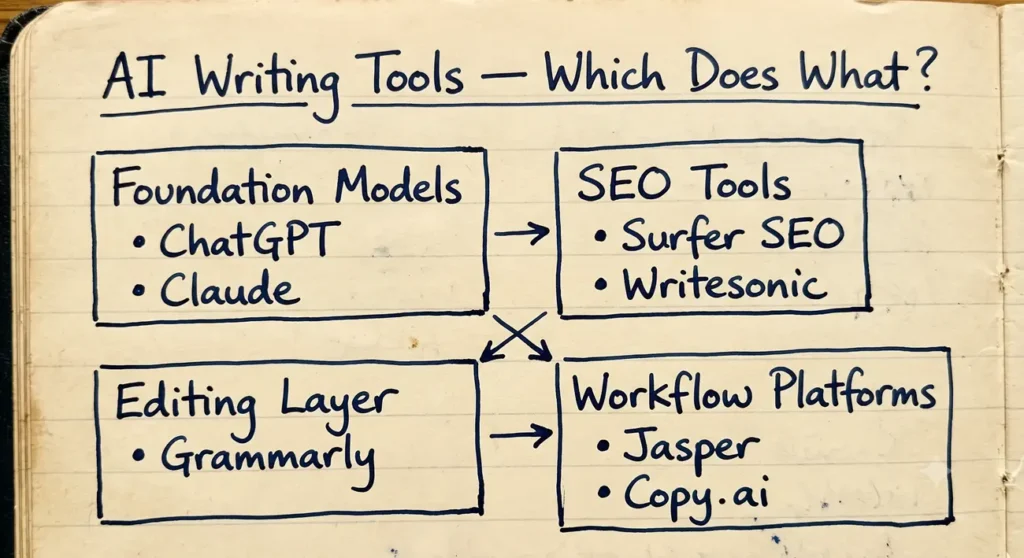
Every “best AI writing tools” list makes the same mistake. It throws ChatGPT, Jasper, Surfer SEO, and Grammarly into one list and ranks them as if they’re competing for the same job. They’re not.
Surfer SEO is a content optimization engine. Grammarly is an editing layer. ChatGPT is a general-purpose assistant. Jasper is a marketing workflow platform. Comparing them is like ranking a race car, a pickup truck, and a minivan. They’re all vehicles. The rest depends on what you’re carrying and where you’re going.
This guide separates them properly. For each tool, we cover what it actually does, what it does badly, who should use it, and whether the price makes sense. No affiliate deals influenced this order.
Quick Reference: Best AI Writing Tools 2026
At a glance: which tool wins at what
| Tool | Best For | Price/Month | Key 2026 Update | Verdict |
|---|---|---|---|---|
| ChatGPT Plus | General writing, research, versatility | $20 | GPT-5.5, Deep Research, Codex | Best all-round tool for most people |
| Claude Pro | Long-form writing, prose quality | $20 | 200K context window, best prose | Best writing quality, period |
| Surfer SEO | Content that actually ranks on Google | $89 | AI Tracker, Mention Gap, AEO tools | Non-optional if SEO is your business |
| Jasper | Enterprise marketing teams | $59/seat | GEO agent, brand voice enforcement | Worth it for teams, overpriced for solo |
| Grammarly | Editing, polish, human authorship proof | Free / $30 | Authorship feature — proves human writing | Best editing layer, not a writer |
| Writesonic | Budget SEO content at volume | $20 | Built-in SEO, 1,000 words/60 seconds | Best value for budget SEO content |
| Copy.ai | Short-form, sales copy, GTM automation | $29+ | GTM Workflows, no-code automation | Best for high-volume short-form only |
Why 2026 Changed Everything for AI Writing Tools
Until recently, these tools competed on one thing: generating text faster. Longer drafts, more templates, cleaner interfaces.
That race is over. The new competition is different.
Search changed. ChatGPT now processes 2.5 billion prompts daily and 65% qualify as search queries. Google’s AI Overviews appear on a growing share of searches. Ahrefs data shows AI Overviews reduced click-through rates on top-ranking content by 58%.
That created two new disciplines every serious writer needs to understand:
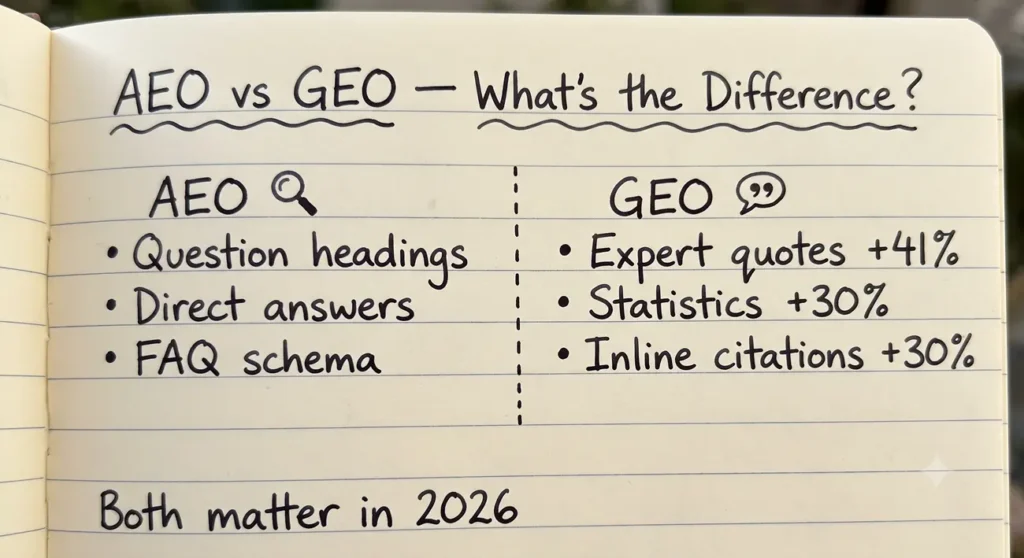
AEO (Answer Engine Optimization) — structuring content so AI systems select it as a direct answer. Question-based headings, concise paragraph answers, FAQ schema markup, unambiguous query resolution.
GEO (Generative Engine Optimization) — convincing AI systems to cite you when generating longer answers. Research from Princeton found expert quotes boost AI visibility by roughly 41%, statistics by around 30%, and inline citations by around 30%.
Every major tool update in 2026 is a response to this shift. The tools that haven’t adapted are already falling behind.
For a deeper look at how AI regulations are affecting content and compliance requirements, see our 2026 AI Compliance Guide.
The Tools — Honest Reviews
1. ChatGPT Plus — Best All-Round AI Writing Tool
ChatGPT is the most versatile AI writing tool available. It handles more task types than any other tool on this list — first drafts, rewrites, research summaries, tone adjustment, translation, keyword clustering, meta descriptions, content outlines, and code.
The 2026 version runs on GPT-5.5, a significant upgrade over GPT-4. Better instruction following. Fewer hallucinations. More natural long-form writing. The free tier runs on GPT-4o mini. The Plus tier at $20/month unlocks the full model.
What changed in 2026:
- Deep Research — synthesizes dozens of sources before writing. The biggest practical upgrade for writers who need accurate sourced output rather than confident guessing
- Codex — agentic coding built into the platform
- 60+ app connectors — Google Drive, Slack, GitHub, Salesforce
- Persistent memory — remembers context across sessions
- Record Mode — meeting transcription and summarization
Where it falls short: ChatGPT does not have live SERP data. It cannot tell you whether your content will outrank a competitor. For SEO-focused content, you still need to pair it with a dedicated optimization tool like Surfer SEO.
The prose quality is good but not best-in-class. For content where the writing itself matters as much as the information — thought leadership, editorial pieces, long-form guides — Claude consistently produces cleaner output.
Best for: Individual writers, bloggers, freelancers, researchers, and anyone who needs one tool that handles multiple content types without a learning curve.
Price: Free tier available. ChatGPT Plus at $20/month. Team at $25/user/month. Pro at $200/month.
2. Claude Pro — Best Writing Quality
Claude is Anthropic’s AI assistant. Among professional writers and content teams who care about prose quality above all else, it has become the preferred tool for long-form work.
What separates Claude from ChatGPT in writing tasks:
Claude follows complex instructions more precisely. It maintains a consistent voice across a long document without drifting. It handles nuance better — the kind that shows up in thought leadership pieces, technical guides, and editorial content. And it has a 200,000 token context window, meaning it can hold an entire book in memory while writing.
The highest-performing content stack in 2026, according to multiple SEO professionals, is: Perplexity AI for research → Claude for writing → Surfer SEO for optimization. Each tool handles what it does best.
Where it falls short: Claude does not have native SEO tools, web search integration as broad as ChatGPT’s, or the app connector ecosystem. It is a writer, not a workflow platform.
Best for: Writers who prioritize quality over speed. Bloggers, thought leaders, journalists, and anyone creating content that needs to sound genuinely human and not require heavy editing.
Price: Free tier available. Claude Pro at $20/month. Claude for Teams at $25/user/month.
3. Surfer SEO — Best for Content That Ranks
Surfer SEO is not a general-purpose writing tool. It is a content optimization engine. If ranking on Google is your primary goal, it is the most important tool on this list.
Here is what it does that nothing else does: it analyzes the top-ranking pages for your target keyword in real time and gives you a content score as you write. It tells you which terms to include, how long your content should be, how to structure your headings, and how your draft compares to the pages currently sitting at position one.
The 2026 updates are significant:
- AI Tracker now covers Gemini in addition to ChatGPT and Perplexity — monitors how your content appears in AI-generated answers
- Mention Gap — shows exactly where competitors appear in AI answers that you don’t
- Sentiment Analysis — whether AI answers about your brand are positive, neutral, or negative
- AI Search Guidelines — one-click citation optimization in the Content Editor
- Auto-Optimize with Version History — every optimization saved, tracked, and reversible
Surfer AI can also generate full SEO-optimized drafts directly in the editor — a 2,000-word article in around 15 minutes. The output needs editing, but the structure and keyword distribution are solid from the start.
Where it falls short: Price. At $89/month it is the most expensive tool here. The keyword research is not as strong as dedicated tools like Ahrefs or SEMrush. And Surfer AI output, while SEO-optimized, needs significant editing to sound like a human wrote it.
Best for: SEO professionals, content agencies, bloggers building organic traffic, and anyone whose business depends on search visibility in 2026.
Price: Essential at $89/month. Scale at $129/month. Enterprise pricing on request.
4. Jasper — Best for Enterprise Marketing Teams
Jasper is a marketing workflow platform. It runs on OpenAI and Anthropic models — the same underlying AI you access directly through ChatGPT and Claude. You are paying for the workflow layer on top: brand voice enforcement, team collaboration, approval queues, 100+ templates, and now GEO monitoring.
The GEO agent added in 2026 is the most meaningful new feature. It monitors how your brand appears across AI platforms like ChatGPT and Grok, then helps you close the gap between what AI says about your company and what you want it to say. For enterprise marketing teams managing multiple brands, this is genuinely useful.
Jasper also leads the category for:
- Brand voice consistency across large teams producing 20+ pieces per month
- Campaign management — brief to draft to approval in one platform
- Surfer SEO integration for SEO-driven drafts
- 500-prompt library with guided prompting for less experienced team members
Where it falls short: Price-to-value for individuals. At $59/seat/month, solo writers are paying a premium for workflow features they don’t need. The same underlying models are accessible through ChatGPT Plus and Claude Pro for $20/month. Jasper’s writing quality is not better than those tools — the enterprise workflow is the differentiator.
No native SERP analysis either. Pair it with Surfer SEO for content that ranks.
Best for: Marketing agencies, enterprise content teams, brands producing 20+ pieces per month who need consistency, governance, and AI search visibility monitoring at scale.
Price: Creator at $49/month. Pro at $69/seat/month. Business pricing on request.
5. Grammarly — Best Editing Layer
Grammarly is not a writer. It is an editor. That distinction matters more in 2026 than it ever did.
With 30 million daily active users, Grammarly has been the dominant editing tool for years. In 2026 it added something genuinely new: the Authorship feature.
Authorship tracks your actual keystrokes and typing patterns to create a verified record that content was human-generated. For freelancers working with clients who have AI-detection policies, or academics subject to plagiarism rules that now cover AI output, this is a real professional tool.
The question of “did a human write this?” has moved from a philosophical curiosity to a contractual requirement in many professional contexts. Grammarly’s Authorship feature is the first serious answer to it.
Grammarly also added an AI Writer for quick phrasing suggestions and paragraph unblocking. It is not built for long-form drafting or SEO, but it handles the “stuck on a sentence” problem well.
Where it falls short: Not a content creation tool. If you are looking for something to draft articles, Grammarly is not it. Use it as the final layer after drafting in Claude or ChatGPT.
Best for: Professional writers, academics, freelancers who need to demonstrate human authorship, and anyone wanting polished copy before it goes out.
Price: Free tier available. Grammarly Pro at approximately $30/month. Business plans available.
6. Writesonic — Best Budget SEO Tool
Writesonic has not made headlines with a single big feature in 2026. What it has done is become the most practical option for solo bloggers and startups who need SEO baked into the writing process without paying Jasper or Surfer prices.
At $20/month it includes built-in SEO optimization and keyword research, Surfer SEO integration, SERP analysis, direct WordPress publishing, GEO and AI search features, and generates 1,000 words in under 60 seconds.
The output quality is not as strong as Claude or ChatGPT with good prompting. But for volume content — a blog that needs two posts per week with solid keyword targeting — Writesonic handles the production work well.
Where it falls short: Prose quality. Writesonic optimizes for speed and SEO structure. The writing itself needs more editing than Claude or ChatGPT output. It is production infrastructure, not a prose quality tool.
Best for: Solo content creators, SEO bloggers, startups that need consistent content production at budget prices.
Price: Individual at $20/month. Standard at $99/month for teams.
7. Copy.ai — Best for Short-Form and Sales Automation
Copy.ai has repositioned itself as a Go-To-Market (GTM) platform rather than a writing tool. Its Workflows feature lets you automate entire content pipelines — from prospect research to personalized outreach to social posts — without writing any code.
For short-form content at high volume: ads, email sequences, cold outreach, social posts, product descriptions — Copy.ai is efficient. For long-form SEO content, it is the wrong tool.
Best for: Sales teams, growth marketers, and agencies running high-volume short-form content campaigns.
Price: Starter at $29/month. Advanced at $69/month. Enterprise on request.
What Nobody Else Will Tell You
Most AI writing tool reviews have affiliate relationships with the tools they recommend. The ranking reflects commission rates as much as quality. Here are the things that usually get left out.
Most specialized tools run on the same models. Jasper, Writesonic, Copy.ai — nearly all run on OpenAI or Anthropic models underneath. You are paying for the workflow layer, not a better AI. For individuals, that workflow layer is often not worth the premium. For teams managing brand governance at scale, it often is.
AI output still needs significant editing. Testing from early 2026 found generic AI tools produced content requiring 60-80% editing to sound authentic. Even the best tools drop to 10-20% editing with good prompting. Zero editing is not realistic with any tool currently available.
Speed is not the same as quality. Tools optimized for speed tend to produce content that reads like an SEO checklist. Tools optimized for quality — Claude, ChatGPT with careful prompting, Surfer with expert use — produce content that earns trust and gets cited. In 2026, citation matters as much as ranking.
The best stack is usually two tools, not one. The highest-performing content workflow in 2026: Claude or ChatGPT for drafting, Surfer SEO for optimization. Add Grammarly as the final editing layer if you need to demonstrate human authorship. Each tool does one thing well. One tool doing everything is usually a compromise.
How to Pick the Right Tool for Your Situation
Solo blogger or freelancer: Start with Claude Pro or ChatGPT Plus at $20/month. Add Surfer SEO if organic search traffic is your primary revenue driver. Skip Jasper unless you are managing multiple clients with different brand voices.
Marketing team: Jasper for brand consistency and campaign management at scale. Pair with Surfer SEO for content that actually ranks. Use Grammarly Pro as the final editing layer before publication.
SEO professional: Surfer SEO is infrastructure, not optional. Its 2026 AEO and GEO updates make it the most complete tool for both traditional rankings and AI search visibility. Pair with Claude for drafting and Perplexity for research.
Student or academic: Grammarly’s Authorship feature matters if your institution has AI-detection policies. ChatGPT Plus for research and drafting assistance. Understand your institution’s policies before using AI for assessed work.
High-volume content production: Writesonic at $20/month generates 1,000 words in under 60 seconds and has the best price-to-output ratio in the category. Quality will need editing — budget for that time.
Fiction or creative writing: None of the above. Look at Sudowrite, which is purpose-built for narrative writing with story structure, pacing, and character consistency.
The AEO and GEO Shift — What It Means for Your Content
Every major update from every tool in 2026 is responding to the same reality: ranking in Google is no longer enough.
ChatGPT processes 2.5 billion prompts daily. 65% qualify as search queries. When someone asks ChatGPT about your topic, it generates an answer from sources it finds credible. If your content is not citable — not structured with clear facts, sources, expert quotes, and direct answers — it will not be cited.
AEO tactics that work right now:
- Question-based H2 and H3 headings that match how people actually ask questions
- Direct, concise answers in the first two sentences after each heading
- FAQ sections with schema markup
- Content that resolves a query without ambiguity
GEO tactics that work right now:
- Expert quotes with named sources and credentials
- Statistics with cited sources — research from Princeton found this boosts AI citation by around 30%
- Inline citations linking to authoritative sources
- Original data or research that cannot be found elsewhere
The tools that help you do this — Surfer’s AI citation tracking, Jasper’s GEO agent, ChatGPT’s Deep Research mode — are worth the investment in 2026. The ones that don’t are optimizing for a search landscape that has already changed.
For more on how AI is changing compliance and regulatory requirements for content, see our EU AI Act & GDPR Compliance guide and our breakdown of the cloud security compliance frameworks affecting AI platforms.
Final Verdict
If you only use one tool: ChatGPT Plus or Claude Pro. Both at $20/month. ChatGPT wins on versatility and app integrations. Claude wins on prose quality. Try both free tiers and pick based on what your work actually requires. For the full head-to-head breakdown between these two, see our ChatGPT vs Claude comparison. If you also use Gemini, our three-way comparison covers all three.
If SEO matters to your business: add Surfer SEO. It is expensive at $89/month but it is the only tool that connects content quality to actual ranking data in real time. Without it, you are optimizing in the dark.
If you run a content team: Jasper earns its price for brand governance, campaign management, and GEO monitoring at scale. Individual writers almost never need it.
If editing quality matters: Grammarly Pro as the final layer before publication. Its Authorship feature is now professionally important for anyone working with clients who have AI-detection policies.
The tools shorten the time from idea to publishable draft. They do not replace the original argument, the fact-check, or the edit that makes a piece worth reading. That part is still yours. For the broader roundup of AI tools, see our Best AI Tools 2026 roundup, or browse every guide PenPonder has tested in the full AI Tools Guide.
Frequently Asked Questions
What are the best AI writing tools in 2026?
For individuals and bloggers, ChatGPT Plus and Claude Pro offer the best value at $20/month. For SEO-focused content, Surfer SEO leads the category with real-time content scoring and AI citation tracking. For enterprise marketing teams, Jasper is the top pick for brand governance and campaign management at scale.
Is Claude better than ChatGPT for writing?
For prose quality and long-form accuracy, yes. Claude consistently produces cleaner, more human-sounding output that requires less editing. For versatility, integrations, and workflow breadth, ChatGPT Plus has more features. Most professional content teams use both.
Is Jasper AI worth it in 2026?
For marketing teams producing high-volume branded content, yes. For solo writers, the $59/seat/month price is hard to justify when the same underlying models are available through ChatGPT Plus and Claude Pro at $20/month. Jasper’s value is in the workflow layer — brand voice, team collaboration, and GEO monitoring — not the AI itself.
What is AEO and why does it matter?
AEO stands for Answer Engine Optimization. It is the practice of structuring content so AI systems like Google AI Overviews, ChatGPT, and Perplexity select it as a direct answer to user queries. In 2026, AI Overviews reduce click-through rates on traditional search results by 58% according to Ahrefs data. Content that is not structured for AEO is losing visibility it used to take for granted.
Can AI writing tools replace human writers?
No. Testing in 2026 consistently shows AI-generated content requires significant editing to sound authentic. The best workflow is AI for structural drafting, formatting, and SEO optimization while human writers provide the original argument, voice, fact-checking, and final editing. The tools shorten production time — they do not remove the need for human judgment.
What is the best free AI writing tool in 2026?
ChatGPT’s free tier running on GPT-4o mini handles most basic writing tasks well. Claude’s free tier is strong for prose quality. Grammarly’s free tier remains the best free editing layer. For anyone creating content regularly, the $20/month paid tiers for ChatGPT Plus or Claude Pro are worth the cost.
What is the difference between AEO and GEO?
AEO focuses on getting content selected for direct answers in AI-powered search features — concise answers, question-based headings, FAQ schema. GEO focuses on getting AI systems to cite your content when generating longer synthesized responses — expert quotes, statistics with sources, inline citations. Both matter in 2026 and the best AI writing tools are starting to optimize for both simultaneously.
Pricing verified from official vendor websites as of July 2026. AEO and GEO statistics sourced from Ahrefs and Princeton NLP Group research. PenPonder does not have affiliate relationships with any tools reviewed in this article.
