

Reviewed by: Mansoor Ali, Technical Editor, PenPonder | Last Updated: July 2026
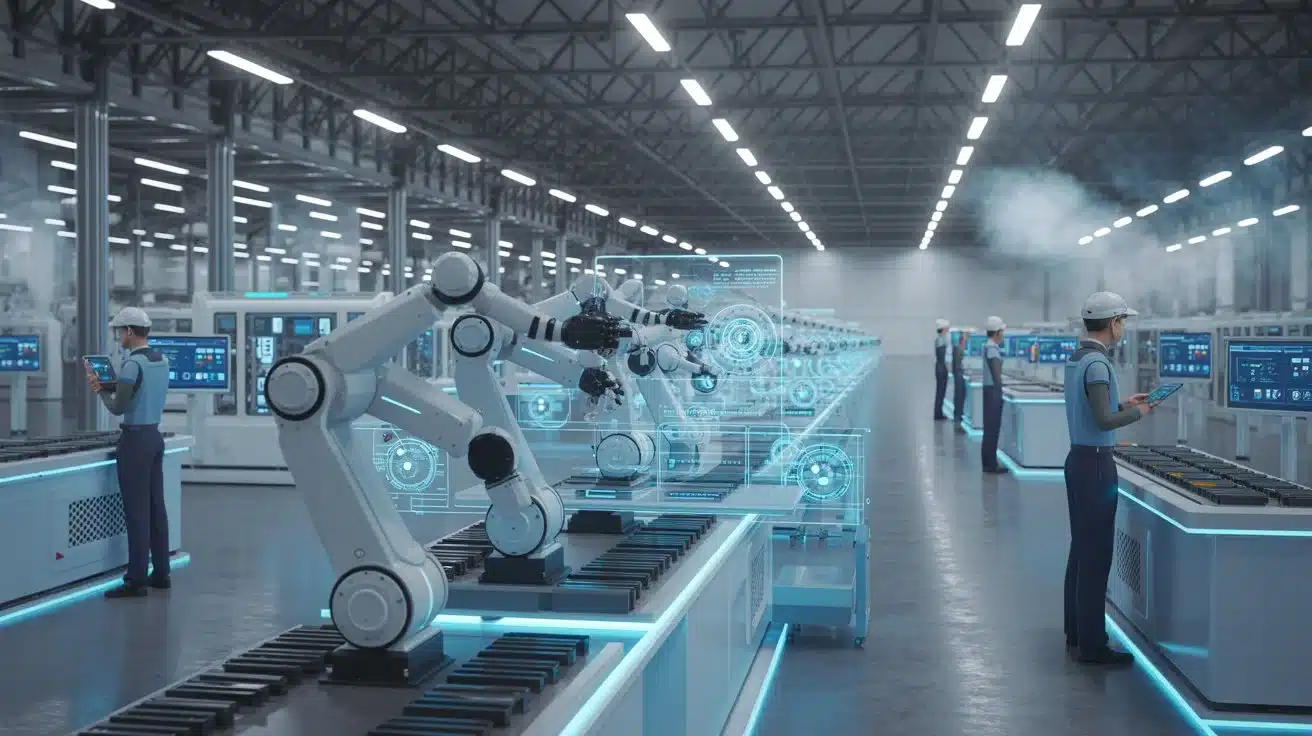
Walk into a modern factory today and you might not recognise it as manufacturing at all. Robots work alongside humans rather than in separate caged areas. Sensors on every machine send continuous data streams to AI systems that predict failures weeks before they happen. Computer vision cameras inspect thousands of parts per minute with accuracy that exceeds what human inspectors can achieve. And digital twins of the entire factory run in parallel, simulating changes before a single machine is touched.
This is not a vision of the future. 56% of global manufacturers now use some form of AI in their maintenance or production operations. The global AI in manufacturing market is valued at $34.18 billion in 2025, growing at 35.3% CAGR. The question for most manufacturers is no longer whether to adopt AI but which applications to prioritise and how to avoid the implementation failures that still affect 30% of AI manufacturing projects.
AI in Manufacturing: The 2026 Numbers
- 56% of global manufacturers now use AI in maintenance or production operations
- The global AI in manufacturing market is $34.18 billion in 2025, projected to reach $155 billion by 2030 at 35.3% CAGR
- Unplanned downtime in discrete manufacturing costs an average of $260,000 per hour in 2026
- Global manufacturing downtime costs an estimated $50 billion annually
- AI predictive maintenance reduces unplanned downtime by 30-50% and maintenance costs by 25-40%
- AI visual inspection achieves 99.8% accuracy detecting defects as small as 0.1mm, surpassing human inspectors who miss 15-30% of defects in routine checks
- Automotive AI manufacturing adoption: 78%. Semiconductors/electronics: 82%. Food and beverage: 45%
- Average ROI by application: predictive maintenance 250-300%, robotics and automation 275-300%, quality inspection 250%, supply chain optimisation 220-250%
- Deloitte reports average 10:1 ROI within two years of implementing AI-driven predictive maintenance
- The “pilot trap” failure rate has dropped from 70% to 30%. But 30% of AI manufacturing projects still fail to scale.
- Fortune 500 companies are estimated to save 2.1 million hours of downtime and $233 billion in maintenance costs annually with full adoption of condition monitoring
The Four Highest-Impact AI Applications in Manufacturing
1. Predictive Maintenance
Predictive maintenance is the most widely deployed and highest-ROI AI application in manufacturing. Traditional maintenance approaches are either reactive (fix it when it breaks) or preventive (replace parts on a fixed schedule). Both waste resources and still result in unplanned downtime.
AI predictive maintenance analyses continuous sensor data from motors, bearings, spindles, and other components: vibration, temperature, current draw, pressure, and acoustic emissions. It identifies the patterns that precede failure. The system detects anomalies weeks or months before human operators would notice anything wrong, allowing maintenance to be scheduled during planned downtime rather than causing an unplanned stoppage.
The performance data is compelling: 30-50% reduction in unplanned downtime, 25-40% reduction in maintenance costs, and the ability to predict failures 4-8 weeks in advance with 85-95% accuracy. BMW uses AI-driven predictive maintenance on conveyor systems to prevent line stoppages. It schedules repairs proactively instead of halting entire production lines for unexpected breakdowns.
The implementation reality: IoT sensor prices have dropped to $0.10-$0.80 per unit, making the sensor infrastructure affordable even for mid-market manufacturers. The gap is no longer hardware cost. It is the AI layer that turns sensor data into actionable maintenance decisions, and the workflow integration that ensures a predicted fault generates an actual work order rather than a dashboard alert that nobody acts on.
2. Computer Vision Quality Inspection
AI computer vision systems inspect components using high-resolution cameras feeding deep learning models trained to identify cracks, misalignments, dimensional errors, and incorrect assembly. The accuracy exceeds human inspectors: 99.8% accuracy detecting defects as small as 0.1mm, inspecting 1,000+ units per minute with consistent accuracy across all shifts, 24 hours a day. Human inspectors miss 15-30% of defects in routine checks due to fatigue, attention variation, and the physical limits of what the human eye can detect.
In automotive manufacturing, AI vision reduces defect escape rates by up to 83%. In electronics and semiconductor production, where precision tolerances are measured in microns, computer vision has become standard rather than cutting-edge.
The most mature quality AI deployments in 2026 have moved beyond detection to prevention. Closed-loop systems fuse inspection data with process parameters (injection moulding temperatures, welding currents, press forces) and forecast quality metrics before the part is produced. When predicted quality falls below threshold, the system recommends parameter adjustments and, in fully automated environments, applies them directly without waiting for human intervention.
3. Supply Chain Optimisation and Demand Forecasting
Supply chains are inherently unpredictable. Demand fluctuates. Suppliers fail. Lead times change. Traditional forecasting methods using historical averages fail to anticipate these disruptions in time to respond effectively.
AI demand forecasting analyses multiple data streams simultaneously: historical sales, real-time inventory levels, supplier reliability data, market signals, weather patterns affecting logistics, and economic indicators. A documented supply chain deployment improved forecasting accuracy by 27% over three years, directly reducing overstock, stockouts, and carrying costs.
AI supply chain optimisation ROI of 220-250% reflects the compounding effect of improvements across the entire supply chain: fewer stockouts, lower inventory carrying costs, reduced expediting fees, and better supplier relationship management based on data rather than instinct.
4. Robotics and Cobots
Industrial robotics is not new. What AI has changed is how robots learn tasks, adapt to variation, and work alongside human operators. Traditional industrial robots follow precise programmed paths and require significant reprogramming when products change. AI-enabled robots and collaborative robots (cobots) can learn new tasks through demonstration, adapt to slight variations in part placement and orientation, and operate safely in shared workspaces with human workers.
The cobot market is particularly significant for small and mid-sized manufacturers that need automation without the capital and programming complexity of traditional industrial robots. AI-equipped cobots can be set up by operators without robotics programming expertise, producing results faster and at lower implementation cost than traditional automation.
Physical AI (combining AI with robotics) is described as the next major wave in manufacturing AI. More than half (58%) of manufacturing leaders report at least limited use of physical AI today, with that figure expected to reach 80% within two years.
Additional AI Applications Gaining Traction in 2026
Digital Twins
A digital twin is a virtual replica of a machine, production line, or entire factory that runs in parallel with the physical operation. AI models feed the simulation with real-time data, enabling teams to test changes (adjusting throughput rates, adding product lines, changing maintenance schedules) without disrupting physical operations. An automotive plant can simulate a line expansion virtually before committing capital. A food manufacturer can test new product configurations without interrupting current production.
By 2029, at least 30% of factories are projected to manage control systems centrally through open automation platforms, largely enabled by digital twin technology. The technology is most mature in aerospace, automotive, and semiconductors where the cost of physical experimentation is highest.
Energy Optimisation
AI monitors power consumption across production lines, identifies waste patterns, and optimises energy usage in real time. In energy-intensive manufacturing (steel, cement, chemicals, glass), energy costs are a primary cost driver. AI systems that reduce energy consumption by 10-15% generate significant savings at the production line level and help manufacturers meet increasingly stringent sustainability and carbon reporting requirements.
Production Scheduling and Optimisation
AI scheduling tools balance workloads across machines, adjust dynamically to disruptions (equipment faults, material delays, demand changes), and reduce idle time. Leading plants report 20-50% task-level productivity uplift from AI-assisted scheduling without reducing headcount. The productivity gain comes from better utilisation of existing capacity rather than adding machines or workers.
Where AI Manufacturing Projects Still Fail
The 30% failure-to-scale rate for AI manufacturing projects reflects consistent patterns in what goes wrong. Understanding them prevents expensive mistakes.
Data quality is the most common failure point. AI is only as good as the data it trains on and receives in production. A predictive maintenance system trained on incomplete historical failure data learns incomplete patterns. A quality inspection system trained on non-representative images of defects fails on defect types it has not seen. Manufacturers who invest in AI before investing in data infrastructure consistently produce worse outcomes than those who sequence the work correctly: data quality first, then AI.
Integration with existing systems is frequently underestimated. A predictive maintenance system that generates failure predictions but does not connect to the CMMS (Computerised Maintenance Management System) to create work orders has limited operational value. A quality inspection system that detects defects but does not feed back into process parameters to prevent them is a detection system, not a prevention system. The AI layer is only as useful as its integration with the workflows that act on its outputs.
Cultural adoption determines whether insights become actions. Maintenance technicians who distrust AI predictions because they do not understand how the system works will override its recommendations. Production managers who have not been trained to read AI dashboards will ignore them. The technology is the easy part. The change management that turns AI outputs into changed human behaviours is what most AI manufacturing vendors undersell and most manufacturers underestimate.
Starting with the wrong use case wastes momentum. AI applications with complex data requirements, long feedback loops, or difficult success metrics are poor starting points. The applications with fastest time to proven ROI are predictive maintenance on critical assets with existing sensor infrastructure and computer vision quality inspection on high-volume, standard product lines. These produce results in 4-8 weeks and build internal confidence for broader deployment.
How to Start: The Practical Sequence
The manufacturers seeing the strongest results share a consistent implementation sequence that produces early wins and builds toward broader capability.
Step 1: Data foundation first. Audit what sensor data you currently collect and where the gaps are. Standardise data formats across systems. Ensure your CMMS, MES, and ERP systems are generating clean, connected data. Clean data is the prerequisite for every AI application. Skipping this step is the most reliable predictor of project failure.
Step 2: Pilot on high-impact, high-data assets. Select 5-10 critical machines where unplanned downtime is most costly and where sensor data is already available. Run a predictive maintenance pilot. Set clear success metrics before you start (target: 10% downtime reduction or 5% fewer defects). Prove ROI in 8 weeks.
Step 3: Scale with integration. Expand to full production lines. Connect AI outputs to existing workflow systems (CMMS, MES). Train operators on AI-driven insights. Document what worked, what did not, and why.
Step 4: Add use cases based on proven infrastructure. A manufacturer with solid data infrastructure and proven predictive maintenance can add quality inspection, scheduling optimisation, and energy monitoring on a foundation that already works. Each additional application requires less implementation effort because the data pipes and cultural adoption patterns are already established.
For how AI capabilities in manufacturing connect to the broader AI landscape, see our What AI Can Do in 2026 guide. For the cybersecurity implications of connected factory systems, see our Network Security Guide 2026. For how manufacturers can structure an AI business strategy that delivers ROI, see our AI for Business 2026 guide.
Final Verdict
AI in manufacturing in 2026 is past the pilot phase for the most impactful applications. Predictive maintenance, computer vision quality inspection, and supply chain optimisation have accumulated enough real-world deployment data to establish clear ROI benchmarks. The numbers are compelling: 250-300% ROI on predictive maintenance, 99.8% defect detection accuracy, 30-50% downtime reduction.
The gap between the early adopters and the laggards is widening. Manufacturers with full AI integration in asset management see 10-20% higher overall profitability than those without. The semiconductor and automotive sectors at 78-82% adoption demonstrate what scale looks like. Food and beverage at 45% and heavy machinery at 38% show where the catch-up opportunity sits.
The 30% project failure rate is a genuine caution. AI in manufacturing requires data infrastructure, system integration, and cultural change as much as it requires AI technology. The manufacturers who sequence these correctly are pulling ahead. Those who buy AI tools before solving data and integration problems are producing the statistics that keep the failure rate elevated.
Frequently Asked Questions
How is AI used in manufacturing in 2026?
The four highest-impact AI applications in manufacturing are predictive maintenance (analysing sensor data to predict equipment failures weeks in advance), computer vision quality inspection (detecting defects at 99.8% accuracy), supply chain and demand forecasting optimisation, and AI-enabled robotics and cobots. Additional applications include digital twins, energy optimisation, and production scheduling. 56% of global manufacturers now use some form of AI in maintenance or production operations.
What ROI does AI deliver in manufacturing?
ROI varies by application. Predictive maintenance delivers 250-300% ROI with average 10:1 returns within two years according to Deloitte. Robotics and automation: 275-300%. Quality inspection: 250%. Supply chain optimisation: 220-250%. Predictive maintenance reduces unplanned downtime by 30-50% and maintenance costs by 25-40%. For a manufacturing facility with $1 million daily production value, preventing one day of unplanned downtime annually pays for many AI implementations on its own.
What is predictive maintenance in manufacturing?
Predictive maintenance uses AI to analyse continuous sensor data (vibration, temperature, current draw, pressure) from production equipment to identify patterns that precede failure. Rather than replacing parts on a fixed schedule (preventive maintenance) or waiting for breakdown (reactive maintenance), AI systems predict failures 4-8 weeks in advance with 85-95% accuracy. This allows maintenance to be scheduled during planned downtime, preventing unplanned stoppages that cost an average $260,000 per hour in discrete manufacturing.
How accurate is AI quality inspection compared to human inspectors?
AI visual inspection systems achieve 99.8% accuracy detecting defects as small as 0.1mm while inspecting 1,000+ units per minute. Human inspectors miss 15-30% of defects in routine checks due to fatigue and attention variation. In automotive manufacturing, AI reduces defect escape rates by up to 83%. AI inspection maintains consistent accuracy across all shifts, 24 hours a day, regardless of environmental conditions or operator fatigue.
Why do AI manufacturing projects fail?
30% of AI manufacturing projects still fail to scale despite the industry’s pilot-to-production failure rate improving from 70% to 30%. The most common failure causes are: poor data quality before AI deployment, insufficient integration between AI outputs and existing workflow systems (CMMS, MES, ERP), inadequate change management and operator training, and starting with the wrong use case that has long feedback loops or unclear success metrics. Data infrastructure must be solved before AI deployment to avoid these failures.
What is a digital twin in manufacturing?
A digital twin is a virtual replica of a machine, production line, or factory that runs in parallel with the physical operation using real-time data. AI models feed the simulation, allowing teams to test changes (throughput adjustments, new product lines, maintenance schedule changes) without disrupting physical production. Automotive plants use digital twins to simulate line expansions before committing capital. By 2029, at least 30% of factories are projected to manage control systems centrally through open automation platforms enabled by digital twin technology.
Statistics sourced from f7i.ai Industrial AI Statistics 2026, Tech-Stack AI Adoption in Manufacturing 2026, iFactory AI Manufacturing Use Cases 2026, Exotica IT Solutions AI for Manufacturing 2026, MaintainX Maintenance Stats 2026, Deloitte Predictive Maintenance Study 2026, McKinsey Industrial IoT Report 2026, and IDC Manufacturing Industry FutureScape 2026. External reference: McKinsey’s AI in manufacturing insights provide additional strategic context for manufacturing leaders. PenPonder does not have commercial relationships with any manufacturing technology vendors mentioned in this article.
